Showing posts with label Neurotic Musings. Show all posts

Sunday, June 21, 2020

Big Apocalypse Energy is my New Aesthetic

Wow guys. 

It's been a long time since I've written an actual full blog post. I guess I just haven't felt very inspired to sit down and journal my thoughts; with everyone's attention span in quarantine being five seconds long--including mine--it's easier to just fume in a pithy tweet, push send, and be on my way, which when you think about it doesn't leave much time for self-reflection, and is probably even a little bit Trumpy.

But ever since mid-March, when we went into COVID-19 lockdown, I've felt a weird combination of doom-and-gloom apocalypse mixed with a new inspired energy to get shit done in this world. Sometimes I feel like a keyboard warrior, but then I remind myself of the real things I've done this year, including working on my own world view and my place in the world.

Leveraging Privilege: A guiding theme for me since last December has been both recognizing and using my privilege--primarily my skin privilege and my education. The way I use my law degree is a big part of that. I've been involved in some cool cases: a class action lawsuit to keep the Pioneers' Home rates reasonable, which helped catalyze legislation that did just that. I worked on election reform and education reform ballot measures, both of which may be on the general election ballot this year. The election measure, in particular, will be monumental if it passes. I helped on the legal side of the recall effort. Both the recall and the election reform measure were upheld in the Alaska Supreme Court. I wrote an article on ballot measures for the election symposium issue of the Alaska Law Review and I am looking forward to publishing my first piece of legal "scholarship" since law school. I try to be responsive when people call me with legal questions or issues, listen to what they say, and guide them in a helpful direction. My new full-time job as a municipal attorney for a mid-sized rural city is rewarding and interesting, though I still miss my former colleagues at the State every day. 

Listening to Math and Science: When the pandemic first started, my cousin who is a biomedical engineer and working on the vaccine told me: "It’s going to be at least 18 months before anything is normal again. They're not really saying that because everyone would riot but that's the reality." So I've adjusted my sense of time to accept that life isn't getting back to "normal" any time soon. It's been so cool watching my brain and girl-crush, Dr. Anne Zink, who is my exact age (!) lead the state through this pandemic, despite the sad politicization of public health. I'm wearing masks in public because it's the kind and scientifically right thing to do.

Black Lives Matter: I'm choosing to engage more actively in racial justice movements because I am more conscious than ever of how my skin privilege has always infused every aspect of my life--from the microcosm of viewing police as protectors (which they always have been to me) to educating myself on the larger issues of reparations and mass incarceration, and sharing what I learn as widely as possible.

Books, Books, Books: Both in my book club and out of it, I am reading a lot more--I always have a book going, and friends and family have really opened my eyes to some great fiction and nonfiction, especially by BIPOC and on issues of race and equality. My goal in reading is to escape and keep my mind sharp but also to self-educate, listen, and attempt good ally-ship devoid of ego. Which means making mistakes, absorbing criticism, and self-correcting without self-defensiveness.

Friends & Family. I've been pretty focused, too, on trying to help friends and family through this pandemic and its fallout. I am so grateful that the beginning of COVID coincided with the start of a new job for me, and with no travel or entertainment, I've been in a better position to donate resources to friends, families, and causes I believe in. I've been trying to be more present for my children and make sure they maintain their connections, and have been incredibly indebted to their amazing dad who is with them all day while I am at work and is much better with kids than I will ever be. I've tried to be in better touch with friends, even though my daily groove is auto-pilot and I fail at this plenty of times. I extracted my parents from Zombie Land NYC and they're in Juneau for the summer thanks to a generous house-sitting gig offered by some dear friends.

Exercise. I've had a fucked up relationship with exercise ever since I was a teenager. I looked at it as a way to excel at sports and lose weight and nothing more. But I've been exercising almost every day since the pandemic started, and even though I still hate every second of it, I have to admit I feel good afterwards and it's helping my mental health a lot more than I thought it would. I still eat garbage, however.

Time and Voice Preservation: I've always said that our time and voices are our two most valuable assets. The way we use our time and the way we use our voices are also the things we can most control. OHM self-promotion has a purpose beyond narcissism, which is authentic humor and advocacy. We all have control over how we use our time. I choose to use it writing, reading, and doing real work in the world that tries to further the things I think are important both in my intimate sphere and in the world at large. I try to use my voice to do the same--litigating free speech claims as a plaintiff with the ACLU to hopefully gain broader speech protections to government workers and minimize fear and corruption in government. And, knowing that silence is not now and never will be an option, saying what I think needs to be said out loud without arguing about it and trying to convince anyone else of my rectitude. I don't get mired down in "the comments" for that reason. I try not to look outward at what others are doing or not doing. I try to be inner-directed as much as possible, though it's always a challenge.

Faith. I'm not religious, though I am ethnically Jewish and fully recognize that the Nazis would have come hard for me 80 years ago. That also drives my actions. I am spiritual, though, and I do have faith that the world can and will be better. I always come back to my favorite line from the Talmud:

Do not be daunted by the enormity of the world's grief.
Do justly, now.
Love mercy, now.
You are not obligated to complete the work.
But neither are you free to abandon it.



Tuesday, February 4, 2020

The Importance of Choosing to Fight Back

On November 18, 2016, less than ten days after Trump was elected president, Sarah Kendzior, PhD, a Missouri-based journalist and scholar of authoritarian regimes, published a column in the online Dutch magazine, De Correspondent, titled: "We're heading into dark times. This is how to be your own light in the age of Trump." 

I've shared this piece before; and if you don't follow Dr. Kendzior's work, I highly recommend it. It's eerily prescient. I keep returning to her words as sort of a guidepost for how best to withstand the pressure-test of our struggling constitutional democracy. One particular section of her column really stands out as a sort of barometer of conscience. She wrote:
We are heading into dark times, and you need to be your own light. Do not accept brutality and cruelty as normal even if it is sanctioned. Authoritarianism is not merely a matter of state control, it is something that eats away at who you are. It makes you afraid, and fear can make you cruel. It compels you to conform and to comply and accept things that you would never accept, to do things you never thought you would do.You do it because everyone else is doing it, because the institutions you trust are doing it and telling you to do it, because you are afraid of what will happen if you do not do it, and because the voice in your head crying out that something is wrong grows fainter and fainter until it dies. That voice is your conscience, your morals, your individuality. No one can take that from you unless you let them. They can take everything from you in material terms – your house, your job, your ability to speak and move freely. They cannot take away who you truly are. They can never truly know you, and that is your power. But to protect and wield this power, you need to know yourself – right now, before their methods permeate, before you accept the obscene and unthinkable as normal.
I was born in 1977, shortly after the Vietnam War ended, but before 9/11 and climate change set us on a course for the enormous and seemingly insurmountable challenges we face today. It was a relatively calm handful of years that I think gave people (especially white people) my age the false impression that domestic tranquility was the norm, when in fact a broad view of history tells the opposite story: that human civilization is just one long conflict, with small breaks in the storm for those privileged enough to enjoy them.

But I also grew up, as a Jewish person, in the shadow of the Holocaust, raised by a Holocaust survivor, given to understand that we had been divested of our property and livelihoods, hunted down, and killed by a white supremacist power structure, and that we probably would be again someday. We were to remain forever vigilant of this. Even and especially in America. We were not to be complacent. In retrospect, my grandmother's obsession with nose jobs was really about assimilation and self-preservation. Ever tactful, she would tell me, "you didn't get your mother's figure, but at least you got her nose!" Our little noses would never tell on us, and we didn't even have to pay a plastic surgeon to keep our secrets.

I guess that's why I have a really hard time accepting the "everyone has to make their own choices" logic about following government orders that are illegal, unconstitutional, or unethical. Yes, everyone has to "make their own choices." But we also have to own the consequences of those choices. We have to view our choices in a historical context. We have to be able to look at ourselves in the mirror and accept that sometimes our choices are the same ones authoritarian collaborators would once have made, when the stakes were much higher than they are today.

Choices, sometimes, are a matter of life and death, and even when they aren't, you can never really count on anyone to choose anything besides naked self-preservation. Everything else--our morals, our consciences-- is subsumed by that raw instinct.

We just watched this happen with Lisa Murkowski's decision to knowingly acquit a President of conduct she knows full well is impeachable. We've watched it since the beginning of the Dunleavy administration, with lawyers and commissioners bending themselves into Auntie Anne's soft pretzels of self-justification to justify the unjustifiable on behalf of venal and craven leadership. 

As Dr. Kendzior said, It's human nature to conform "because everyone else is doing it, because the institutions you trust are doing it and telling you to do it, because you are afraid of what will happen if you do not do it, and because the voice in your head crying out that something is wrong grows fainter and fainter until it dies."

Accepting that has been hard for me, but I am working on it. Everyone has to make their own choices. True enough. So I'm choosing to fight back and to not let my voice die. There is inherent value in that. Even in a David-and-Goliath battle where all you can do is brace for impact and go down swinging, (to mix at least three metaphors), it is worth making a record of your objections. There is inherent value in simply saying and acting in a manner that preserves for history that "this is not okay." There is inherent value in "being the change you wish to see" by taking care of yourself and others.

To do that effectively, though, you have to be inner-directed. You have to divorce yourself from outcomes. You have to treat every day as a self-contained vacuum in which--just for today--you continue to make the wrongness known. You have to abandon any expectations of company. It's a lonely fight, but the alternative is worse.

The alternative is abdicating your time and bartering your voice to purposes and causes that you know deep down are just plain wrong. It's easier to pretend it's not wrong. It's easier to tell yourself that you're the adult in the room. That you need this or that job. That this will all blow over. Really, it's easier to not care at all. And many people make that choice, I suppose. But it's not one that I am personally capable of making, and I guess that's just something I also am working on accepting about myself.

We can't just sit around waiting for things to get better, because they won't. If we care about our future as a society, about empathy, about compassion and ethics in our leadership, then we can't really afford to choose willful blindness and complacency.


Saturday, December 14, 2019

The Place Where Memory Cannot Reach

The Auntie who raised me from birth while both my parents worked full-time spent the first five years of her life in a concentration camp in Nazi-occupied Romania. She, her mother, and her two older sisters had been transported there, by train, in the dead of night without notice; the soldiers said they were going somewhere safe.

When, five years later, they returned to the home they’d left behind, they found it had been looted and stripped down to the studs. Their Christian neighbors had bet on Fani, Peppi, Betty, and their mom not returning.

But the family beat the odds and reunited with their dad and husband who had been interned in a Russian labor camp, eventually making their way to Israel and then to New York City.

Rain or shine, Fani believed children should be outside every single day and “valk in ze fresh ahyer.” We would frequently make the several mile trek from my family’s apartment in the Bronx to hers in Northern Manhattan, along the way weaving through the multicolored living monuments to immigrant life in 1980s New York: dim Irish pubs here, bustling corner pizza joints there, falafel carts, synagogues, Puerto Rican car washes, Black hair-braiding salons, aromatic Korean fruit stands, fancy Dominican dress shops. I could always talk her into buying me sweets.

We typically walked hand-in-hand and had developed a special signal for “stranger danger.” A disheveled man talking to himself, the smell of marijuana, or a hostile looking commuter would prompt Fani to squeeze my hand hard, wordlessly telling me to keep my wits about me and be ready to flee.

Speaking in a patois of Yiddish, English, and Romanian, she would tell me, her “pitsulah madeleh” (little girl), apocryphal stories of Romanian girls who were snatched off the street and forced to work in the traveling theater; she would read me clippings from the newspaper about some recent kidnapping in Queens or Staten Island, clucking her tongue at these inevitable tragedies.

Despite the fact that New York was a little sketchier then, I never felt the least bit unsafe. The stories Fani told me and her anxieties seemed silly, preoccupied, and overprotective rather than linked to reality. Only in retrospect, as an adult, did I realize that Fani’s vigilance was an artifact of her trauma and that she was always ready to anticipate a threat and escape it. She always believed the other shoe was about to drop and bristled at the sound of German—surely a reflex buried deep in a place within her mind that not even her own memory could reach.

I think that’s why the experience of having my livelihood, along with that of only one other Jewish woman from my office, illegally taken by the State felt different than an ordinary employment dispute. I knew that we had both done an impeccable job representing our clients. I knew we had been fired for exercising our constitutional rights in expressing dismay and fear at the rise of Trumpian loyalist authoritarianism in our own state. And I knew that divesting Jews of their property and livelihood was a tried and true tactic and a bellwether of much worse to come.

I watched in horror as families were separated and actual concentration camps sprang up on the southern border of the United States, and wondered what I could do about it; but not for one second did I feel immune or apart from these things. I knew I was next. I was resigned to Trump until 2024 and beyond. I made sure my family’s passports were up to date. 


I accepted, with a cold resignation, that of course the chief propagandist for the Dunleavy administration would question my ability to parent and threaten to call state OCS and have my children taken away from me, all while calling me paranoid, crazy, angry, unhinged, accusing me of playing "the Jewish card" and hurling every other venomous invective she could conjure simply for pointing out that which is actually happening.

It is impossible to convey to those who have not carried it the weight of epigenetic trauma; the way its tentacles seep like black mold into the interstitial spaces of your consciousness, to the places memory cannot reach.

Anyone whose family has suffered under white supremacy understands this: Black Americans whose families were irreparably shattered by the slave trade; indigenous peoples whose land, language, and way of life were stolen; Jews who have been stripped of their property, the opportunity to use their intellect, their lives; migrant families who, in fleeing gang violence at home, are torn apart by the sadistic maw of Trump’s Big Beautiful Wall.

It is fruitless to engage those without sympathy or understanding and try to make them grasp this type of trauma. The only thing you can do is simply turn away from bullies, sadists, gas-lighters, and those devoid of empathy and wish them well in the healing of their own pain, which is of course what drives their cruelty.

Fani died of breast cancer a couple of years ago. I was glad she got to meet my children—I brought them to her apartment where she made them waffles and played pick-up-sticks with them. We watched the 1/9 elevated subway train rumble back and forth between the Bronx and South Ferry from her 15th floor window. 


I can still feel her squeezing my hand.


Saturday, September 21, 2019

Born at the Right Time

“I was born at the wrong time.” 

Do you ever say that to yourself? Or hear other people say it? I hear that a lot up here in Alaska, which—perhaps *slightly* more in myth than in reality— is 100 rolls of duct-tape deep in wilderness survivor, free-thinker types. Like peeps who are all about climbing into their aluminum skiff and disappearing for a week to shoot their own hot dogs in avalanche country.

Let me be the first to say: that ain’t me. Not by a country mile. Don’t get me wrong, I LIKE camping and hiking and boats and gardening and stuff. I just don’t want to like, HAVE to grow my own kale to survive. Like I don’t want my ability to raise a healthy crop of nasturtiums to be the only thing standing between me and the Grim Reaper.

Which is why I know I was born at the right time. The era of the single-serve Costco guacamole. The time of battling unsupported accessories for Apple products instead of, say, the Confederacy.The days of weighted blankets and meditation apps as a cure-all for sensory overload. 

And I know I’m in the minority here, but I will die on this hill: When the Zombies come, I’m just gonna go. It’ll be like oh I can’t use Wayze to get from Rock n’ Jump trampoline park to the Cheesecake Factory ever again?

Fuck this shit. I’m OUT.

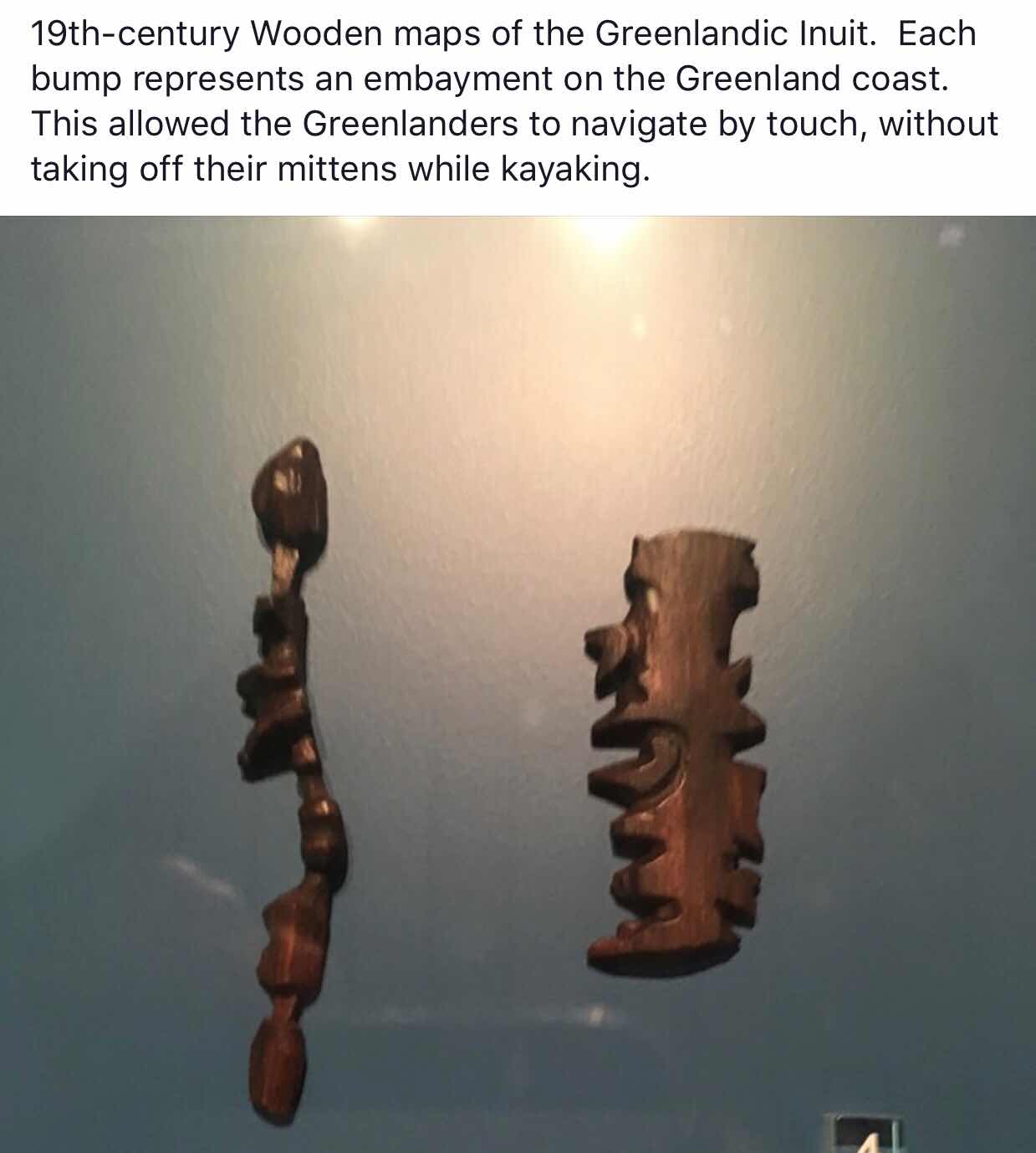
I thought about this when a friend posted something he’d seen in an exhibit at a museum in Anchorage: Nineteenth century wooden maps that the Greenlandic Inuit used to travel through their icy, fjord-dotted wilderness in kayaks. Each bump on the wooden stick represents a piece of the Greenland coast. They would keep these sticks in their mittens, and navigate the coast by touch.

Um .... WUUUUUUUUUT.

This, above all, is how I know I was born at the right time. Do you have ANY IDEA how FUCKED I would be if I had to navigate the coast of Greenland? In the time before Trump threatened to buy it? In a kayak? With a bumpy stick hidden in my FUCKING MITTENS?!

Without fail, kayaking makes me vomit; and I’m lucky if I can successfully use Google maps to find that one dude’s house—the one who has all the Little League gear my kid needs—in the depths of the Mendenhall Valley.

I want to see an old married couple kayaking around Greenland in 1800 arguing about how to get to the next fjord:

“My mitten stick says it’s this way!”
“Honey I think we paddled past it four icebergs ago.”
“I think you’re feeling the wrong bump.”
“I think I know how to feel a stick map in my own mitten, thank you very much!”
“It’s getting late and we might hit whale pod traffic. I think we should stop that other kayak and ask for directions.”
“Absolutely not! I know exactly where we are!”

No thanks. 2019 sucks donkey tits, and there’s not much light at the end of the tunnel, but at least hell has GPS.


Friday, September 6, 2019

Nature, Nurture, and the Illusion of Free Will

I’ve been thinking (and therefore posting) a lot about my maternal grandfather, Alexander Cournos, this week. 

I often think and write about this "Russian Jew," as one newspaper article called him, around Labor Day, because he was an early union organizer for the IWW and was imprisoned for “sedition” and "free-speaking during war time" under the Espionage and Sedition Acts. 

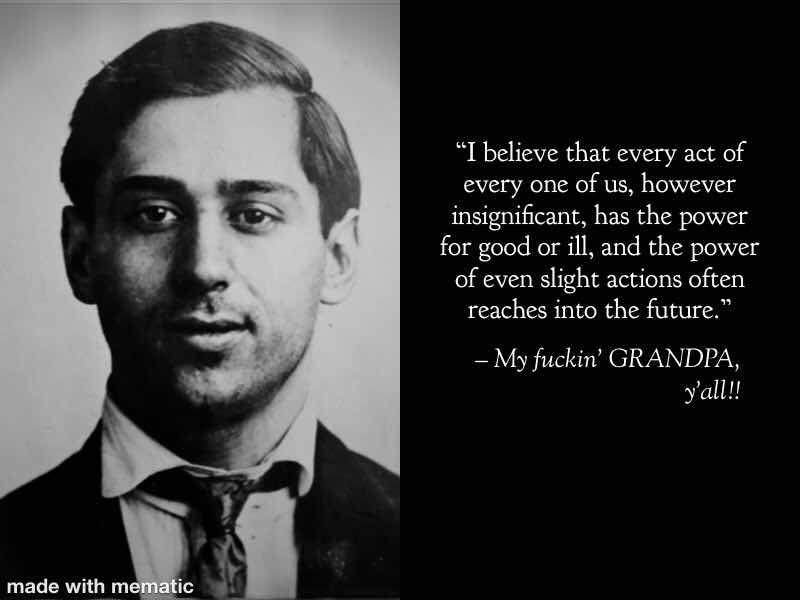
I never met him; he died of a brain tumor in 1948 when my mom was three years old. We have information and records from the Michigan Labor Archives about his trial and imprisonment in Leavenworth, his refusal to take a plea deal, letters he wrote from prison, a single photograph (his mug shot), and some newspaper coverage. 

After one of my grandpa-related posts, an O.H.M. reader found this excerpt from a 1923 (?) newspaper in which he explained to a reporter why he refused "conditioned commutation" of his sentence, which I gather was an offer to exchange his liberty for a promise not to union organize again:
Says Alexander Cournos, one of the Chicago group, under a 10-year sentence for free-speaking in war time: 
I refused conditioned commutation because I believe that every act of every one of us, however insignificant, has the power for good or ill, and the power of even slight actions often reaches into the future. My acceptance of compromise would have made it just that much harder for the next man, for every other man, to live up to his principles. It seems to be unthinkable that a self-respecting man would yield his own civil rights in such a disgraceful bargain; certainly I will never help to fasten chains on my fellow men . . . no killing of men's bodies can kill the ideal they have stood for. It is only slavishness of spirit that can betray their souls.
I had never read these words before a reader alerted me to them, but I haven't stopped re-reading and thinking about them since. They made my mind start spinning around an axis of genetics, free will, nature, nurture, spirituality, purpose, suffering, and other lofty concepts as I tried to take meaning in, and distill some sort of lesson from, what he had said. 

I would never dream of comparing myself to an actual political prisoner, but I do feel like a metaphorical one at times. This month, for some reason, has been especially hard for me. I cannot seem to get over the loss of my "work family," which I lost for speaking out against Trump. Each day I spend working alone, without them, I miss their insights, laughter, and wisdom. I grieve this loss daily and I feel both literally and physically alone almost all the time.

As tough as I try to act, and be, and as much as I try to ignore it, I have a hard time hearing and reading what other people are saying about me, and the names they are calling me, on their blogs, on the radio, and so on. I don't like the role I have fallen into, but I also do not feel like I am able to abandon it. It's almost like I am free-climbing on a cliff wall, trying to ascend to the top, and there's no way to get back down without summiting. I take full responsibility for putting myself on this path and I don't regret it, but I do wonder if I ever really had a choice to begin with.

Reading my grandfather's words gave me chills, mostly because I could have written those very words, and have, in a more modern way and slightly different context, nearly a century later. It made me question my long-held atheism and lack of spirituality. My mother pronounced the similarity "eerie" and my dad, a science writer, attributed it to genes.

I have my grandfather's hair, coloring, and eyes, and the Mona Lisa smile in his mug shot seems to imply a congenital defiance that my mother, his daughter, has also leaned into in her own career and activism. Believe it or not, I don't actually want to be "doing this," whatever "this" is. As I said on a recent podcast, I look forward to the day when I can comfortably return to blogging mostly about parenting and makeup as opposed to the collapse of democracy as we know it. But that day seems like a long way off at this point, and so I need to somehow gear up for the long-haul.

Realistically, we could be living under the sadistic, un-American, and compassionless Trump-Dunleavy regime until 2024 and 2026, respectively. Even just the preliminary stages in my First Amendment lawsuit against Dunleavy and Babcock--filed nearly a year ago--will be ongoing until nearly a year from now. In other words, this is a long-game and it's not a fun one. And when it's finally over, there will be little to do other than survey the wreckage it has left behind, for me and others, and to attempt to rebuild and reclaim what was lost to us as citizens and individuals.

For now I am finding strength in what my grandfather said. I am telling myself he is watching over me, even if I don't actually believe that. I am trying to heed his warning that "every act of every one of us, however insignificant, has the power for good or ill, and the power of even slight actions often reaches into the future." I am trying to view this as a calling rather than a choice, even if it's really a choice, because I'm starting to realize that the line between choices and callings are blurrier than I'd imagined.

I am thinking about what my grandfather said about civil rights (specifically and eerily, the right to free speech), about not yielding those rights in a "disgraceful bargain," and about how refusal to yield them has implications beyond oneself, how yielding them was "unthinkable" to him (and to me) and how if something is unthinkable, it is usually undoable as well.

In another of his letters, he explained to his mother, my great-grandmother, that he was not choosing to stay in prison to spite her or make her unhappy; that his "personal happiness would be greatest by being with" her. "But," he went on, "there are other things besides personal happiness."

But there are other things besides personal happiness. But there are other things besides personal happiness. But there are other things besides personal happiness. I keep trying to remember these eight words; I repeat themselves in my own mind, daily, as a sort of rosary or a mantra to get me through to the next bruising day of existing in this self-inflicted, battering purgatory.

My grandfather could not possibly have known that his only grandchild would one day, almost 100 years later, read his words from an old newspaper and find comfort and inspiration in them. But he clearly knew that the things he did, said, and wrote, "however insignificant", had the "power to reach into the future," and that there are "other things besides personal happiness." I know I would do well to remember all of that. And I try my best to do so every day.

I like to think that, somewhere, somehow, my grandfather is looking down at me with that same knowing smile.


Tuesday, August 13, 2019

The Myth and Futility of Being Good

I was never very good at being good, though I tried. 

I worked hard in school. I tried to be a good friend. I aimed to please. I got good grades and excelled at sports. I wanted everyone to like me. I would cry when they didn’t. Sometimes trying to be good worked, and sometimes it didn’t. Most of the time it felt like pushing a boulder up a hill, Sisyphus style.

When I failed at this type of “goodness,” one of two situations was typically present: either the words or actions required for me to succeed were irreconcilable with my values and principles, or I felt defensive about maintaining my own narcissistic self-image of “goodness” at all costs.

Just yesterday, someone corrected my use of a term as offensive to a certain culture. Years ago, I would have bristled at that. I would have rolled my eyes, become defensive, and dismissed the criticism as coming from a “snowflake.” 

But years of these types of interactions, and reactions to my writing, have taught me that actions mean a lot and so do words. How we use words (or don’t use them) matters. So I thanked the person for teaching me something new about words, vowed to use that word differently in the future, and got on with my day.

I rarely get offended anymore, mostly because I am no longer too invested in my own “goodness.” I don’t have an image of myself as “good” that I need to maintain. I recognize that I make mistakes, take risks, act recklessly at times, indulge in narcissism and foolishness, and am subject to justifiable criticism. 

A lot of it.

Rather than denying this, my time feels better spent looking in the mirror and contemplating my own role in damaging systems, rather than expending energy on an all-out campaign of self-defense, self-justification, and self-preservation at all costs.

True snowflakery is the inability or the unwillingness to do the hard work of self-assessment and self-reckoning. It's the inability or unwillingness to accept criticism without bristling in hostility, shutting down, flouncing out, or boomeranging it all back at someone else. It's the inability or unwillingness to step back and think meaningfully about your role in problematic systems, behaviors, and actions. It's the inability or unwillingness to exemplify good character when no one is watching, or do the right thing even when you have to pay a price. I learned all of this the hard way, both through my own words and actions as well as other people’s.

Someone I love sent me a quote this morning from an unknown author that really resonated with me:
The woman you are becoming will cost you people, relationships, spaces, and material things. Choose her over everything.
I made that irreversible choice a long time ago. In retrospect, I was born already having made it. It's living with the consequences that's the hard part.


Thursday, June 6, 2019

But I Still Haven’t Found What I’m Looking For

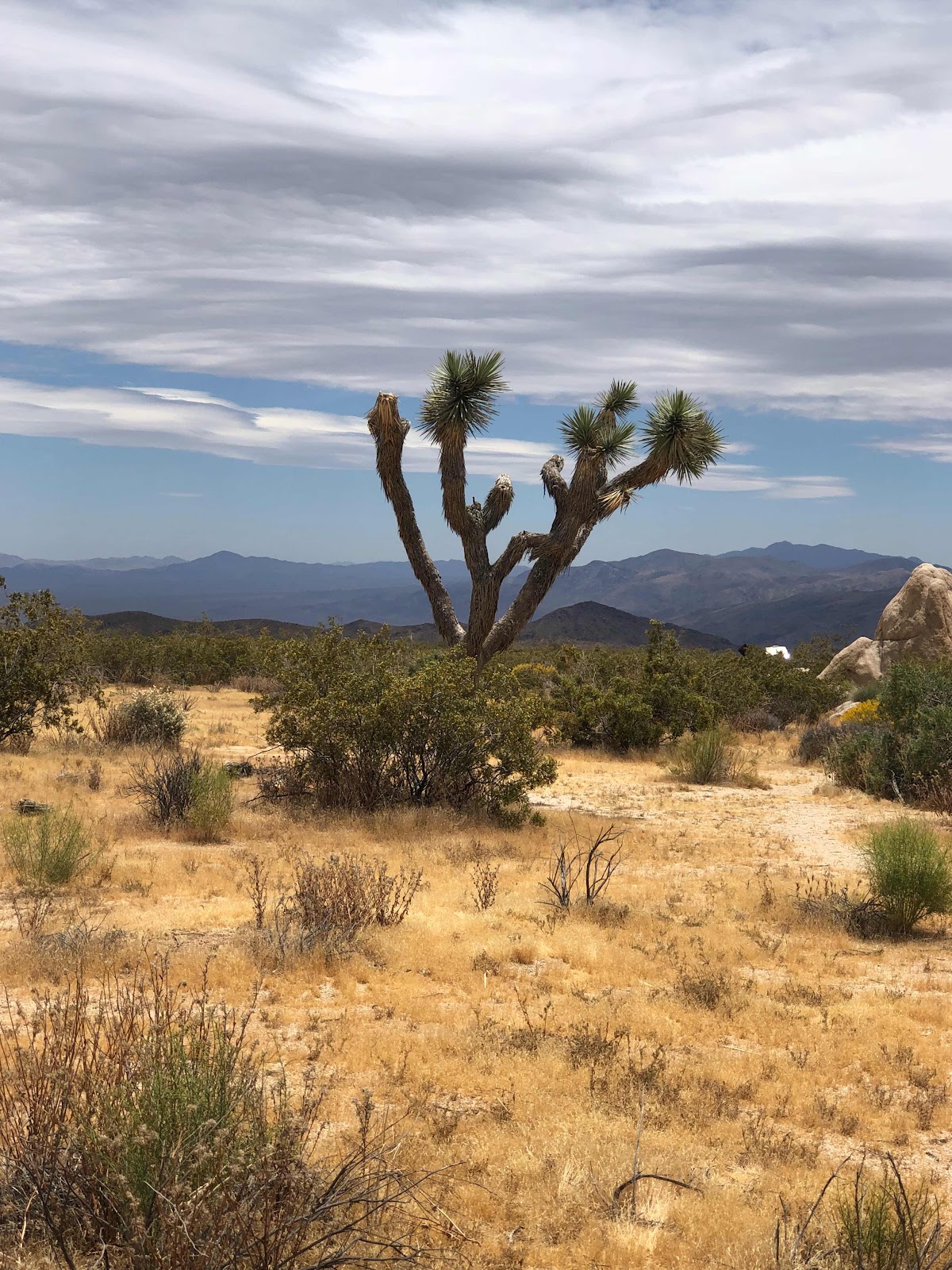
Last week, for the the second time in my life, I was lucky enough to touch a Joshua tree. 

My three college roommates and I, scattered across the country, decided to skip our 20th college reunion and meet up in Palm Springs instead. Driving through the park, listening to (what else) U2, it was easy to imagine how this alien landscape once inspired a musical opus.

Yucca Brevifolia. That's the Joshua tree's scientific name. It's endangered, like all living things, by climate change. Something between a tree, a cactus, and a cartoon out of a Dr. Seuss book, the Joshua tree grows only in the deserts of the southwestern United States. Per Wikipedia:
The name "Joshua tree" is commonly said to have been given by a group of Mormon settlers crossing the Mojave Desert in the mid-19th century: the tree's role in guiding them through the desert combined with its unique shape reminded them of a biblical story in which Joshua keeps his hands reached out for an extended period of time in order to guide the Israelites in their conquest of Canaan. 
The Joshua tree has a deep and extensive root system and can live for up to a thousand years. (WUT). The evergreen leaves are dark and sharp, flowers bloom only intermittently. 

I put my right hand on the trunk of one of these trees and thought about the tattoo I had inked on the back of my neck (shoutout High Tide Tattoo) shortly after the 2016 election. It was one word in lower case typewriter font, with an ellipses: "unless . . .". It refers to one of the last lines in Dr. Seuss's The Lorax: "unless someone like you cares a whole awful lot, nothing is going to get better. It's not."

Even then I recognized that I would need a permanent reminder of the work I knew was coming. The work of caring. The work of trying to make things better. Problem was, I was naive and blinded by privilege, because I thought I would be able to do that comfortably, loudly, without real sacrifice, without pushback, from a place of safety and support. I was wrong. Extremely wrong. And I've been wrestling with that miscalculation and its ramifications ever since. I overestimated my friends and I underestimated my enemies. I grew more cynical than I already was. I lost faith in "the system," whatever that is, and I lost the ability to trust people. I'm never getting those things back. They are gone forever, and that's just something I need to accept.

Most days I just try to go about my business. I seek out work and when I get it, I do it well. I pay my bills and provide for my kids. I shuttle them from baseball to arts camp, driving the same miles of pavement over and over, listening to the same songs on the radio. I numb my feelings and distract myself with sugar, intoxicants, online scrabble, and books. I don't exercise enough and I cry a lot. For the state of the world, mostly, and out of self-pity for my disillusionment, shame, and the isolating limbo I find myself trapped in. I despair that this is never, ever going to end. And by "this," I mean exactly that: This. Everything. This time. The dumbest time. All of the irreparable damage it has done to families and to our national zeitgeist.

But now I'm thinking back to the Joshua tree. 

I didn't realize it until I researched it later, but it turns out that I've got more in common with this weird looking tree than I do with most people. I have a deep and extensive root system that propelled me here. I can outlast the elements (maybe). I can reach out my hands. I can try to be a beacon. 

Standing next to that tree, I thought about how easy it is to just wander off into the desert; crawl under a boulder with the lizards and the scorpions; lie there until you fade to black. That's the easy way. The hard way is to stand there: weird, resilient, waiting. Reaching up, reaching out. Just taking in and absorbing whatever punishments the universe metes out and whatever gifts it delivers.

Looks like I'm taking the hard way.


Monday, May 6, 2019

Needs Improvement

Caring for myself is not self-indulgence. It is self-preservation, and that is an act of political warfare.”

—Audre Lorde, A Burst of Light and Other Essays. 

You are a warrior. 

They have told you so, often. So it must be true. You certainly feel wounded enough. Then why do you not believe it? Why do you not feel like a warrior, here in bed, in the middle of the day for fuck’s sake, under your weighted blanket? The one given to you in a hard time by a fellow mother. One with real pain. With real problems, not of her own making.

Unlike you. 

This is a fake problem of your own making. You did it to yourself, and now you need to find your own way up and out. You are responsible for your own happiness, and you are abdicating that responsibilty. The children are at school (you dropped them off today) and it’s quiet except for those goddamned parakeets. The bit of work you set out for yourself this morning is done, and you lack capacity for more. You read a few pages of a novel, but can’t seem to focus. It’s not a book you ordinarily would have chosen, but here you are, trying anyway.

Trying.

The tears come when you think about what the others might be doing right now. Your other family, the one you haven’t seen since winter and will never see again. Not ever. Not in the same way, at least. They took that, and it’s never coming back. Self-indulgent self-pity is not the same as self-care, is it?

Self-care. Ugh. The term is so corny. So First World, new-age journey, hot yoga, truth-living. You think about bubble baths and soft leggings that arrive in the mail wrapped in plastic, paid for with plastic. Fake. You know you don’t deserve these fake things, because apart from everything else, you are too sad to exercise, even though you know exercising will make you less sad. Ironic.

“Apart from everything else.” That was a great turn of phrase favored by someone you used to talk to every day, but aren’t allowed to anymore. You feel trapped under the weight of your own victimhood and inability to cede to bullshit. You never intended your voice to operate as an act of defiance, and yet it has done just that for as long as you can remember. Every other day in elementary school, you would end up on the green Naugahyde couch outside the principal’s office, waiting to be beckoned in and scolded. 

“BEHAVIOR: NEEDS IMPROVEMENT.” (That was the worst mark available for behavior). It was on every report card. Sometimes it was even followed by two—TWO— exclamation points with a frowny face under the !! 

Even now, you can see it.

You haven’t changed in any way that matters in the past three decades, and you’re not going to. So what will you do instead? You summon from memory a college text book—an Audre Lorde quote, and then descend into a Wikipedia hole, reading about her work, her poetry, her life. Now that’s a warrior.

Self-preservation as an act of political warfare. The idea resonates. You think about refusing to leave your home. Refusing to disrupt your children’s lives. Swipe-deleting toxic people. Shrugging as you give up on them. Ignoring them. The determination to continue existing and resisting and thriving where you are, as acts of both self-preservation and affirmative aggression. 

Because that’s really what it is. It is an act of aggression and defiance simply to continue your work on this earth in the face of people who want you to shut up, get fucked, get raped, be broke, move away, die. They’ve told you all of those things too. They tell them to you every day. And yet here you are, still, anyway.

Maybe you can call yourself a warrior afterall.


Saturday, March 16, 2019

The Inevitable Trauma of Existing

Whenever I see a baby, my body tells me to make another one, but my mind tells me the opposite: that the future is too tenuous, too brutal, for the next generation; and a small pang of wistfulness bordering on envy rises briefly to the surface of my consciousness. Not wistfulness or envy for when my kids were babies, or having more babies, but about actually being a baby.

It must have been so easy, I think to myself. Sitting in a car seat just looking around. Waiting for a grownup to come along and give you a bottle or plop you down in a high chair and cut your cream cheese and jelly bagel into tiny bite-sized pieces. Sure, you're one hundred percent vulnerable and exist at the whim of the adults around you. On some level you know this, that you could literally be sitting in your own shit for hours. But if you're consistently well cared for, it probably barely registers. 

You're a blank slate of potential, cabined only by your genes, your environment, and luck. In other words: everything. You have no idea what's coming: the inevitable trauma of existing.

Life is a total shit show and it beats every last one of us to a bloody pulp in one way or another. No one wants to say that out loud because it’s a scary fact to face. No one gets out of here alive. And no one gets out without taking a few knocks and bearing a few scars. There are so many shitty things that happen to every one of us. You can feel grateful for your blessings while at the same time acknowledging how hard it is just to BE.

The vulnerability of infancy never really goes away. Yes, you're in control, but not really. You realize that you're the grownup now, and you can eat Apple Jax for dinner if you want, and maybe you feel like life is good but sometimes it's just awful and your sense of control reveals itself to be an illusion. 

Maybe your kid goes to rehab or overdoses, or is bullied in school, or is the bully, or gets into a car accident with a drunk driver. Maybe you get raped or molested. Maybe your best friend dies of breast cancer. Maybe you see their body taken away on a stretcher. Maybe you get fired from a job you loved. Maybe someone you trusted betrays you. Maybe you have a chronic mental illness that keeps you in bed, unable to move, for weeks at a time. Maybe you can't pay your bills. Maybe your spouse leaves you for somebody else. Maybe your ex is a stalker or impossible co-parent who doesn't pay child support. Maybe you fall down some stairs and end up in a wheelchair. Maybe your computer fries in the sun and you lose the novel you've been writing for five years. Maybe your house burns down and takes all your family heirlooms with it. Maybe you finally have to put your dog down--your loyal companion for so long. Maybe you screw up and go to jail. Maybe you run away from a good thing because you're self-defeating and scared.

Maybe that feeling of vulnerability--that inevitable trauma of existing--is enough to make you curl up into a tiny ball, put your hands behind your neck and your head between your legs and earbuds in your ears, under a weighted blanket, in the dark. As dark as you can make a room, and you feel like life finally has you beat in the seventeenth round.

But then there are glimmers of light. Like maybe you fall in love again. Maybe your kid wins a soccer scholarship. Maybe you stand on a mountain ridge under the sun with your friends, your cheeks ruddy and the wind in your hair and your damp butt on a mossy rock, and you look out over the ocean and taste sea salt on the smushed cheese sandwich from the bottom of your backpack, and it's the best thing you ever ate. Maybe tears form in your eyes while you're skiing down a mountain listening to the Beatles or watching the sun melt into the horizon on a faraway beach. Maybe something makes you laugh so hard you almost burst.

Maybe someone bakes you a pie, or knits you a hat, or invites you to a party, or buys you lunch, or writes you a letter, or a song. Maybe you write your own songs or buy someone else lunch. Maybe you feel the rush of performing in a play or telling a story to an audience. Maybe you get a promotion. Maybe you learn to play the guitar. Maybe you finish your degree. Maybe you save someone's life without knowing it, or they save yours. Maybe you put your head on someone's shoulder or they put theirs on yours. That's the good news.

The good news is that human connection, love, and empathy are First Aid for the inevitable trauma of existing.


Friday, March 8, 2019

When Love Comes to Town

Anonymous guest post from a dude in Juneau, in honor of International Women’s Day:

I once read a story that went something like, “Love is not two people gazing at each other, but rather two people looking in the same direction together.”

I’m well on my way to 50. It seems very apt, as you reach middle age and are single or unmarried, that you begin to feel a gnawing sense of doom. The sky, which for so long you have looked to and dreamed at, feels likely to come crashing down at any moment and crush you with the weight of the entire atmosphere.

With age you hopefully gain wisdom, a larger sense of respect, a truer sense of what love really is, and what you absolutely don’t want to repeat in terms of life and love errors.

And then you eventually meet someone. Someone who changes your whole paradigm.

This person might just challenge your very core beliefs. She might teach you a trick or two that you never thought of before. She has a sparkle in her eye that you’ve seen hints of before, in other women, but never at the level she brings it. You begin to realize that every mistake you’ve made or heartache you’ve endured was to teach you a specific lesson meant for a future together.

With her.

And then you tell her your entire life story. You tell her shit you wouldn’t even tell your mom about. You write songs about her. You talk about Bernie Sanders and what his presidency could mean for America. You share dreams of Val Davidson running for governor and winning.

My dad once told me, “Never touch a woman in anger, only in love.”

Even though my dad was my hero, we had a different view of life. But he was spot-on in this respect. For too many men, in too many sociocultural pods, the idea that we are above the women in our lives – our partners, mothers, sisters, daughters and otherwise – is pervasive. It’s an example of millennia of genetic muscle-memory that lets powerful males control equally powerful women with impunity.

Compassion and empathy, and even sympathy, are not taught as core skills to men by their fathers (or their mothers) for the most part. Boys aren’t allowed to cry, and girls aren’t allowed to hit back. Instead, many girls are told that they need to be good wives and mothers before good doctors, lawyers, teachers or otherwise. Many young boys are told by their dads that women are property and should be subservient to their authority.

The men of this world need to look in the mirror and— hopefully with some sense of equality and loss of entitlement—learn to honor and respect the women in their lives. This could be difficult and almost an exercise in futility given the centuries of male-dominated indoctrination in this hemisphere, but it’s possible with work.

The women of this world need to stand up and refuse to be silent any longer. Don’t take that shit, sister.

If we all looked more to the Celtic and Alaska Native cultures – where goddesses and the moiety are honored and revered – we might be in a better place as a society.


Saturday, February 9, 2019

It Will Not Surprise You to Learn That I Played Rizzo in the Camp Production of Grease

“A hickey from Kanicki’s like a HAWLMAHK CARD!” 

I still remember that line from my one and only tread across the boards in my tour-de-force role as Rizzo in the 1989 sleepaway camp production of Grease.

Today, as I reflect on what must’ve been the mindset of the teenage counselors who cast me in this role, I realize it wasn’t my captivating voice or embodiment of character that won them over. Nor was it the undeniable chemistry between me and Kanicki, ably played by my best friend, Chuck, who grew up to be a professional actor and thus quickly eclipsed me in the acting arena.

Quite the opposite: Those counselors viewed me as a promiscuous semi-delinquent troublemaker, and they thought the role wouldn’t be too much of a stretch. 

In retrospect, I’m not sure how kosher it is (at least by today’s standards) to type-cast a 12 year-old girl as a chain smoker who accidentally gets pregnant? And her solo is literally just bullying another girl for being a sober virgin who doesn’t curse? And her biggest laugh line is about hickeys? All in 50s lingo that sounds super dated and weird? Like that wouldn’t fly today, right?

I didn’t ever WANT to be bad though, is the thing. I actually wanted very much to be GOOD. I tried hard to be good, but my refusal to shut up was the thing that always did me in. I liked to rile up my friends with silly stories and one-woman showmanship. I got kicked out of class for talking almost every week, it felt like. I hand-wrote stinging, poison pen letters to my romantic rivals. In short, my words got me in trouble then and they get me in trouble now.

But you know what they say. Once a Rizzo, always a Rizzo.


Friday, January 25, 2019

Now What?


I liked this quote from the poet Mary Oliver, who died earlier this month. It's a good question, and one I've been struggling to answer lately. I don't know the answer and I'm spending more and more time trying to figure it out. 
Ever since I was unconstitutionally fired from a job that I loved and performed to near-perfection for over a decade, I've been on an emotional roller coaster of rage, hope, and uncertainty. 

The questions and ruminations keep spinning in a blur like hamsters on a wheel inside my head, and I keep giving myself the “self-care” task of moving on with the serenity prayer on loop: accept the things I cannot change or control; have the courage to change the things I can; and find the wisdom to know the difference. It helps me to divide the first two into categories:

Things I Can’t Control & Therefore Should Ignore

1. What other people think of me.
2. What other people say about me.
3. What people in power do with their power—whether it’s to victimize me or validate me.
4. How other people respond to difficult situations.
5. The content of other people’s character.

Things I Can Control & Therefore Should

1. My basic life habits (eating, sleeping, exercise).
2. Who I allow into my life.
3. How I spend my time.
4. How I expend my energy.
5. How I use my voice.
6. How I respond to threats and fear.

It’s helpful to just list these things for their general application to life and to help me answer Mary Oliver’s question. I don’t know what the answer is. Honestly I’ve been super depressed since early December, and I’ve spent some time since then just wishing I could be in a fentanyl coma and wake up when everything is easier again. 

But I know that’s not an option, and that I need to be patient and let the answer to what’s next for me just sort of unfold. Fortunately the things I can control outnumber the things I can’t, at least by my count. 

For now, at least, I’m going to try to focus on that.

Sunday, January 6, 2019

Letter to My Grandfather

Dear Grandpa,

That's probably what I would have called you, had we met. As far as I know, I'm your only grandchild, and I think about you all the time. Especially lately. A couple of months ago someone asked me, "if you could have a conversation with anyone, alive or dead, who would it be?" 

I said you. 

I have aaaaaaallllll the questions for you. What made you unafraid? Or were you actually secretly afraid constantly and pretending you weren't, like me? Why did you care about the things you cared about? What made you help start the labor movement? Even as you were being tried and convicted for sedition? And in prison all those years? What was it like there? 

Thanks to mom's research I only have the one letter you wrote to your mom and some history books, but that's not the same thing as talking to you obviously. Your mom clearly thought you were kind of a reckless nut job, but you'll be pleased to know that my mom (your daughter!) is totally on board with my reckless nut-jobbery.

You're very handsome in your mug shot, I must say. Like dude, you were kind of a ten! I wonder what you were thinking at the moment this picture was taken. It almost looks like you're laughing a little. I can see the fight in your eyes, and I know that little half-smile. It's a "fuck you, I'm playing long game three-dimensional chess, motherfuckers" smile. 

I see it in the mirror on my best days.

You would not even believe how stupid the world is now. Actually, you probably would. The President is a sadistic tire fire. The constitution is under attack and our whole democracy is in peril. Oh! And they hate us Jews again. Surprise! LOL! (That stands for Laugh Out Loud). Hating the Jews never goes out of style. If it's three things you can count on in this life, it's death, taxes, and anti-Semitism.

I think maybe you do know this, actually; even though I don't believe in God, an afterlife, spirits, or ghosts. (I bet you didn't believe in that stuff either). I want to believe in them, though, because when I do, I imagine you really are looking out for me and watching everything that's happening and telling me what to do next.

I cried a little on the chairlift today sitting next to Paige thinking about you. She asked if I was crying and I lied and said it was just the wind in my eyes. I bet they didn't have chairlifts in 1920s' Pennsylvania, just guessing. Paige is your great-granddaughter and she just turned 11. She's so cool. Like so much more well-adjusted than me. She makes me feel better about myself. I bet you would never imagine in a million years that you'd have a great-granddaughter who skis in Alaska. You barely even knew my mom because you died when she was a toddler and you didn't even get to meet Aunt Alexis. 

But I still feel like you know us. 

People tell me I'm a badass, but it's not true. I cry all the time under my weighted blanket, and feel like I totally fucked up my whole life just by banging pots and pans for what I think is right. 

People are so cold and mean, it's crazy. It's amazing the things people will do and say. The people and systems you think you can count on but can't. LOL. Look who I'm talking to. You totally know this already. I hope you're reading the shit people say on the internet and LOL'ing and exacting vengeance from above on all of my trolls.

Anyway, Grandpa, I wish you were here so I could tell you everything that's happening and ask you what I should do and how to stay strong in my convictions. If you could keep sending me signs, that'd be great.

Love,

Elizabeth


Monday, December 31, 2018

The Externality Trap

I'm not sure if this will be my last blog post of 2018 or my first of 2019, but either way, it's a new beginning for me in terms of my outlook on the future. In 2019 (barring some intervening catastrophe, which I always secretly feel is around the corner) I'll be looking for kindness, reason, and allies in the repudiation of silence. I'll be looking to feel useful, safe, and valued in my work. And I'll be fighting for human rights and our constitutional norms while cursing about boob hairs and Twinkies on my blog. But mostly, I will be looking within myself for guidance on what to do (or not do) next. 

My mom texted me this:
Being resilient means using adversity to gain strength. That’s what you can do now. I know I’m right about this. Don’t let yourself feel defeated. That’s a form of surrendering to the enemy. Life has some nasty unfair turns. Don’t let external events define your sense of who you are.  
Sadly the world is fairly corrupt. The longer you live the more you learn from experience that this is true. And under Trump we are fighting to maintain even the most basic democratic norms, ones that we thought we could take for granted. This is a dark time and unfortunately you are directly experiencing the consequences of it. But you will overcome this adversity—you have what it takes to do that. So fight the thought that you are defeated.
Separately, she wrote that whatever successes I've had in my life have been because of who I am, and not any job I've had. She pointed out that just because someone else does something to me doesn't mean that anything about me has changed; and that's because a person's talents and motives reside within them.

That's the part that really stood out to me: The idea that we let external events define our sense of who we are, and we do it a lot. At least I do. Most of us seek some form of external validation driven by ego. Does this person find me attractive or want to date me? Will I receive this award or that? Will I get the credit I deserve? Will I win some contest or race? Will this person be mad at me if I say/don't say/do/don't do something?

And on and on, ad infinitum.

What my mom said resonated with me so much because I realize that I do a lot of this and it's unhealthy. I've done it with men and I've done it with work and I've done it with blog traffic and I've done it with activism. It's the idea that we are somehow reliant on an external force of some kind to determine our own happiness, and this traps us into ceding control of our self worth to another person or circumstance.

It's a more grownup version of a sign hanging in my son's second grade classroom that reads, "Rule #1: You are Responsible for Your Own Happiness." It's a great first rule of life in general.

I'm not too into New Year's resolutions. I think they're kind of corny and basic so I don't like to admit that I make them to myself every once in awhile. But I guess this is the year I am resolving to climb out of the externality trap and take responsibility for my own happiness once and for all.


Sunday, December 23, 2018

Putting My Life Back Together

Wow you guys. Wowowowowowowow.

Not gonna lie, this was pretty much the shittiest three weeks of my life to date, which I guess all things considered is a good thing, as I have lots to be grateful for. Chief among them: healthy kids and spouse, family and friends who love me, and skills that I know will be well-used in new and nobler pursuits.

Still, being unceremoniously and illegally booted from an institution I've served with unblemished distinction for over a decade felt like an enormous betrayal and a loss, and it was. I lost my work family. I lost my community. I lost my sense of daily purpose and my intellectual outlet. I lost faith in the people and the institutions that I was naive enough to believe would protect me. I lost them at the hands of people who don't know me for reasons that have nothing to do with my work. And I'm not sure any of it will ever be repaired, and I know I will never be the same.

I've had moments this week when I expressed to friends that I wished I was dead. This is not to be confused with being suicidal. I would never in a million years commit suicide, because I would never do that to my kids. Also, I have way too much left to live for and to do on this earth. 

But I think it's important to be open and authentic and real about how upset I am, how wronged I feel, and how profoundly I am grieving. That is what my readers expect of me, and that is simply an honest reckoning. Feeling robbed of a part of your existence does make you want to die, because part of you has, in fact, been killed. I think it's okay to say that, even to the trolls who keep sending me links to unemployment insurance and the vindictive sadists who targeted me.

At the end of the day, though, my mom said it best. The real successes I have had are because of who I am, not because of a job. And I can't make everyone happy, but I know what's right and wrong, and I'm not afraid to say it, with four letter words or otherwise, because this is America and we have freedom of speech and the press for a reason. So I am putting this long chapter of my life in the rear view mirror and focusing on three things: (1) using my voice and my time in ways that feel authentic and meaningful to me; (2) moving on with my life and my career; and (3) making sure that what happened to me never happens to anyone else ever again.

You can stay tuned for all of that right here, because I'm not going anywhere.


Sunday, November 25, 2018

That Jewish Stuff

"That Jewish Stuff." That's what my mom calls it. 

I hadn't heard her call it that before. Not in those words. Keep in mind that my mom is a big fan and also a practitioner of therapy. She's always telling me to "get some therapy" and that my kids should have therapy. When she saw some signs of anxiety in Paige, she told me I should nip it in the bud and "get her some therapy."

"I wish I'd gotten you some therapy when you were younger," she said, referring to my bouts with eating disorders, depression, and anxiety. "This is just in our DNA. It's that Jewish stuff." She was referring, of course, to the genetically-encoded hereditary disposition to anxiety and depression that Jews typically experience. Epigenetic trauma is not a well-studied science, and what studies have been done cast doubt on the concept of trauma—which Jews have had a bunch of—as printable on DNA.

But it's as much a cultural thing as a DNA thing. My generation of Jewish children was only one generation removed from the Holocaust. We grew up hearing horror stories and could trace immediate family members to concentration camps. We were taught to bristle at the sound of the German language and to fear German Shepherds and boycot German products. We were always on some sort of high alert. We were communicated this idea that the Holocaust was around every corner and we should have our passports ready to flee.

It wasn't a constant onslaught of this message. It happened in hushed tones and whispers almost absorbed through the ether. I was raised by a Romanian Holocaust survivor who had fled to Israel and then America, and she wasn't shy about sharing her experiences, no matter how terrified or young I was. It was communicated that you don't reveal you are Jewish in mixed company unless you have to, but among Jews you code-switch and pepper your speech with Yiddish.

It was like living with the idea that the Bogeyman is real.
And I think all of this fear, be it inherited or learned, just has a psychological impact. My generation of Jewish children also grew up during a sort of halcyon time that allowed us to assimilate and take full advantage of the privileges of white skin. The period of domestic prosperity and tranquility between Vietnam and 9/11 was the exception, not the rule. And so sliding into darker times feels like The Moment™ is Here. At all times, we are ready to fight or flee in The Moment.

We are especially on guard about Trump and rising anti-Semitism, or most of us are. Many of us hustle hard for broad social justice because we know what happens when people don’t. We are primed to fear persecution for our intellectual work, abilities, or incomes. We have had property stolen from us and we are scared. 

And though I can’t speak for them, I imagine it's the same for ancestors of colonized and enslaved POC. I think people who have been colonized, persecuted, or enslaved simply experience persecution and threats differently. We feel them differently, more viscerally. And it makes it hard to stay sane, make good decisions, or maintain objectivity or hope.

But still you have to, because what else can you do?


Tuesday, November 13, 2018

Pushing the Limits

I know a lot of people who do extreme sports and activities. This is Alaska, after all. Paragliding, big backcountry skiing and snowboarding, ice climbing. I don't do any of that shit. I hike and I ski and I love being outside, but I'm way too much of a wimp to get my pilot's license or take an avalanche class or jump off Mt. Roberts on a piece of canvas.

I'm fascinated, though, by all my friends who do this stuff. It seems SO SCARY to me. And the most interesting thing is that they all describe the exact same feeling: the adrenaline rush, the adventure, the sense of pushing a boundary. The focus it takes to get wherever they are trying to go. The ever-present specter of consequences.

That's sort of how I feel about writing and speaking my mind and "living my truth" or whatever. It's like I've new-agedly "set an intention" to be unapologetically and very publicly myself in the hopes that I reach people and open new perspectives for myself and others. You can call it over-sharing, but I just call it my hobby and overall it's very rewarding.

I understand that this particular hobby comes with risks. In the four years I've been writing O.H.M., many people--mostly men and older women--have given me a ton of unsolicited advice about what I should do and say on here. It's all cloaked in benevolent concern, but it feels like repression and accusation to me--with the implicit/explicit message that I should be embarrassed and afraid.

I should curse less. I should have ads. I shouldn't talk about vibrators. I shouldn't have my face in my profile. I should worry about being too frank. I should worry about my kids (I don't write about my kids as much anymore, and never without their permission). I should worry about my job. I should change this or do that or the other thing. And it's all sort of in service of this vaguely patriarchal concept that overall I should be less. I should chill, because I am "too much," and "too much" is dangerous. That I should say less and say it more quietly and safely, and be less salty and aggressive or something, and I guess I just don't want to do that.

My poor mom. 

I let her come to her grandkids' parent-teacher conferences when she was visiting last week and she was amazed. "I never got a good report like that about you," she said. "I dreaded parent-teacher conferences. Elizabeth went to the principal's office. Elizabeth fell out of her chair again. Elizabeth talked in class. Elizabeth spoke out of turn. Elizabeth is distracting the other students. Elizabeth fell out of her chair again."

She said the chair thing twice, because I guess I fell out of my chair a lot. And someone was always telling me to get back in it. And I guess now that I'm an adult, I'm just gonna sit back and fall over in my chair every day on the internet, because I fucking feel like it and no one can stop me.