Friday, December 24, 2021

And I Turned Out Fine


This is not an original idea. (I don’t think I’ve ever had one of those). But I read it somewhere in the abyss of the internet and wish I could credit the author. The gist is this: if you were treated badly as a young person but “turned out fine” and on that logic justify treating other people like shit, you did not in fact “turn out fine.”

I guess this is called “lateral violence,” which is some 2021 term for professional hazing I suppose—the experience of being a young professional woman who is abused or mistreated by other women at work. 

I am 44 years old. This mostly happened in my 20s with early jobs, before I went to law school, but it happened in more subtle and long-lasting ways after that as well. 

My shift supervisor at my first food service job screamed and yelled at us constantly for every infraction and didn’t back down until we yelled back. 

My first boss in the New York City publishing industry made me cry that deep, shame-drenched cry in the bathroom every week—the one where you can’t catch your breath. 

The dean of my law school humiliated me by screaming at me in front of hundreds of students and faculty for trying to promote a pro bono graduation requirement at my law school. My first clinical law professor was a terrifying presence who excoriated us for our every tiny mistake. (Also shame cry on those).

A young mother who supervised me during an internship had an enormous temper tantrum at all the interns during trial preparation. 

My first real promotion as a lawyer had to be wrested from female management by pointing out that a man with the same level of experience as me was coming to the office—in my literal former position—at a full salary range higher than I had after five years. My favorite mentor whom I trusted and loved so much later abetted my illegal firing and shit-talked me in a deposition. 

All women. Is it their fault as individuals? Not really. They were just playing their part in a formidable system intentionally designed to cannibalize women.

This is not to say that I have not had some positive women mentorship experiences over the course of my work life, which started at age 17 and continues to this day. I certainly have, but they’re the exceptions that prove the rule. 

Now I mostly work alone. I don’t have any one person, much less layers of people standing sentinel over my professional progress, and that’s fine with me. But I do miss mentoring young women at work because it gave me the chance to rectify misery that I had experienced and that had hurt me so deeply. 

I think about my mother. 

Her childhood fucking sucked. She was an orphan by 11. She grew up in foster care. She went to medical school when there were only nine other women in her class of over 100. She has supervised residents ever since and always told me the same thing: 

Just because your life was hard doesn’t mean you should want other peoples’ lives to be hard. That makes zero sense. There is no value in that. It doesn’t fix what happened to you. It doesn’t change the past. It’s spiteful, vengeful, and petty. It doesn’t make the world better. In fact, it makes it worse. And when women do it to each other, the only people who benefit are the men around them. My mother is my lodestar for female mentorship.

Recently one of my former mentees got a big new job. She wasn’t the first and most certainly won’t be the last to get a bigger, more prestigious job than I could ever hope to have or want, and I couldn’t be happier for them. This time I almost cried when I found out, because I was thrilled for her and also because I knew I had an impact on her career and helped give her an extra boost of confidence now and then. I don’t think there’s anything particularly admirable or especially noble about that. It should be the default course of conduct and the norm. Women should support and uplift each other or else we will never make any progress at work or anywhere else.

We should normalize that. I haven’t always done it successfully, but I always try. If we can just do that—one tiny interaction at a time—we really will turn out fine. 

Tuesday, December 14, 2021

Practice Tips for New Lawyers


13 THINGS YOU MIGHT NOT LEARN IN LAW SCHOOL


Whether you represent government clients or private clients, there are certain strategies to practicing law that you might not learn in law school. Understanding these and keeping them in the back of your mind will improve your practice anywhere. These are 13 things you might not learn in law school.


1.Research creatively.


The foundation of any good attorney work product is thorough legal research. But good legal research involves more than just typing a bunch of search terms into Westlaw or Lexis, printing off cases and journal articles, and Blue Booking them to perfection. Yes, you need to do all of that. You need to look at every relevant case, and every case cited in those cases. But in doing that, you need to think carefully about the facts of each of those cases and how those facts differ in meaningful ways from the case you’re working on, including—and this is important—the procedural posture and context those cases were decided inAnd often, you need to go beyond the case law. You might need to research legislative history by studying prior versions of legislation and legislative hearings. You might need to go into old files in your office that may have records you need. You might need to look at similar cases involving the same litigants that may not be reported on Westlaw or Lexis, or that only exist in a trial-level court file somewhereYou might need to delve into the commentary on the court rules or study the local rules of the court you’re in. You might need to go online to many other sources aside from Westlaw or Lexis. That’s researching creatively.


2.Write like an advocate.


When you brief the court, you need to write like an advocate. Writing like an advocate does not mean ignoring the weaknesses or bad facts in your caseThis is important-you can never get away from bad facts. They are what they are. But advocacy means underplaying or distinguishing those bad facts and weaknesses in favor of your case’s strengths. An advocacy brief is not a bench memo to a judge, research memo to a senior attorney, or an advice memo to a clientIt should not be neutral in tone or expose/attempt to reconcile every hole and problem in your caseAdvocacy writing showcases the strengths of your case, and why you should win. Every time you write a paragraph in a brief to the court, whether it’s a minor motion or an appellate brief, read it back to yourself and ask yourself two questions(1) “how doesthis paragraph advance my client’s interests?”; and (2) “will this paragraph give the judge a reason to rule my way? If you can answer yes to those two questions, you are writing like an advocate.


3.Think strategically.


Thinking strategically means taking the long view of your case. Being strategic doesn’t mean playing games or being conniving. It means taking a close look at the chessboard. Think about how each thing you do on a case may or may not yield a certain outcome down the line. If you are a visual learner, draw a decision tree of options and ways things could play out. Think about your theory of the case: what is the case about in one sentence? What does it all boil down to? What are you trying to accomplish or convince the judge of, other than that you should simply win? Even if you do win, what will be the final outcome for your client? A Pyrrhic victory is not always a good thing. Think broadly and strategically about your case—not just how to write the perfect sentence or achieve small victories along the way. Sometimes a small concession will yield a bigger victory down the line. Thinking strategically about your case in a broad sense will help you determine the smaller procedural steps you need to take to get to the best result.


4.Know your enemy & know your audience.


Do opposition research. Opposing counsel is not your friend. The judge is not your friend. Read and find out everything you can about your opposing counsel and your judge, including what they have written and how they have behaved in other cases, so you know who you are dealing with and what you can expect. Talk to other people who have dealt with opposing counsel or who have appeared before the judge in your case. In a similar vein, the people you work with--your clients, colleagues,and superiors can be your friends—but they are your clients, colleagues, and superiors first. When you’re writing to these audiences, obviously you are not writing an advocacy piece the way you are when you write to the court, but you are always writing clearly, concisely, and professionally in service of your clients’ interests, and that brings me to the next point:


5.Project confidence—not bravado.


There is a difference between confidence and bravado, and senior attorneys and clients can tell the difference. Confidence comes from having done your homework and preparation and being as sure as you can be of the answer.  If the answer isn’t clear, and it often isn’t, you can still be confident in even that conclusion. Bravado comes from being insecure and afraid and investing too much of your own ego in your practice. In addition to being transparent, indulging in bravado will cloud your judgment and prevent you from getting to the right answers to a legal problem. When delivering an answer to a legal problem to a client or senior attorney, or when arguing before the court, always project confidence, which means acting capable. But don’t pretend you know things you don’t know.  Don’t be afraid of simply saying some version of: “I don’t know the answer to that at the moment, but I am confident I can find it out, and will get back to you ASAP.” Clients, senior attorneys, and judges will appreciate confident candor and a right answer later a lot more than they will appreciate bravado and a wrong answer now.


6.Find a mentor, or ten.


There are people you will encounter in your career whom you admire and want to emulate, and who are good role models and mentors. I can rattle off about ten different people who have been mentors for me. Identify these people early on and cultivate relationships with them, if they are willing to reciprocate. Bounce ideas off of them. Run drafts of documents past them. Seek their professional advice whenever you can.


7.Observe constantly—including yourself!


The reality is there are terrible lawyers and there are great lawyers, and there’s everything in between. Everyone has different strengths and weaknesses as a lawyer. Observe as many lawyers as you can and get a sense of their style. Think about what they do that you want to emulate. What do they do that you want to avoid? Read as many motions and briefs as you can. Attend as many hearings, oral arguments, client meetings, moot courts, depositions, and trials as you can, so you can figure out mistakes you never want to make and things you always want to do. And you want to be observing yourself as well. For example, onething I always like to do is order the CD of oral argument from the court after I have an oral argument. Oral argument is probably one of the things I’m the least comfortable with, so I like to go back and listen to myself and the judge to improve my oral advocacy and see what worked and what didn’t.


8.Ask questions.


Often a client or senior attorney will rattle off a list of demands and questions at a mile a minute. You will sit there scribbling away, and go back to your desk and realize you only wrote down three legible words of what they said. Don’t be afraid to go back and ask for clarification—multiple times if necessary. You will feel stupid doing this, but you shouldn’t. What’s stupid is to embark on a huge project not knowing what was asked of you. Make sure you have a good understanding of what is being asked of you and realize you may not gain that understanding during your first conversation on the topic. 


9.Own your mistakes.


Everyone makes mistakes in practice. For example, you might send confidential discovery or an email to someone who shouldn’t have received it or you might forget a court deadline or a discovery deadline. If you make a mistake, admit it quickly and seek help fixing it if necessary. Don’t paper over mistakes or pretend they didn’t happen because you’re embarrassed or you think you’ll be able to hide it. Most of the time, you shouldn’t be embarrassed and you can’t hide it. Pretending otherwise only makes things worse. Practicing law isn’t brain surgery, and unless you’re a capital defender, no one is going to die because you made a mistake. (Even then, a mistake you make probably won’t kill your client). There are very few mistakes in this profession that can’t be fixed or remedied in some way or other. The best thing to do when you realize you’ve made a mistake is to acknowledge it quickly to the client, court, or senior attorney and take whatever steps you need to take to fix it.


10.Cross-examine your client.


A big mistake many new lawyers make is to accept their clients’ version of reality at face value. Avoid this at all costs. Accepting your client’s narrative harms your case and it harms your client’s interests, because the things they omit and leave out can ambush you later. What you don’t find out now, your opposing counsel will find out later. You have to get a little bit adversarial with your clients sometimes. You have to “cross-examine” them and question their conduct and what they’ve done in a given situation. They will get defensive, but don’t let that stop you from getting to the real facts, not their editorialized version of the facts.


11.Create a paper trail.


If you are in court, or anticipate you will be, always be thinking about the record in your case. E-mail and letters can be your friends. Memorialize conversations with opposing counsel in e-mail or a letter, even when doing so is not required by the civil rules. If appropriate, memorialize privileged conversations with clients and senior attorneys (and mark them privileged and confidential, of course) so everyone is clear on what advice was given and what course of action was decided upon. If an issue of professional ethics arises in a case, consult with bar counsel or ethics counsel and do a memo to your file that you did that, describing the ethical issue and the advice you received on how to resolve it.


12.Don’t reinvent the wheel.


If you’re a new lawyer working on a problem, chances are you’re not the first person to confront that problem. Noone gives a new lawyer an issue of first impression and expects them to crack it straight out of the box. In addition to all the traditional research methods, there are short cuts you can take that will not depreciate your work product. Every office has templates of motions, letters, etc. that have been used in various situations. Save yourself time and your clients’ money by availing yourself of existing resources to get the job done more efficiently.


13.A draft is not a draft.


Anytime you give a client, senior attorney, or anyone in your office a draft to look at, it really shouldn’t be a “draft.” It should be the most polished, final work product you can produce. No one wants to read stream-of-consciousness ramblings or see typos or grammatical mistakes in a draft.


Monday, December 13, 2021

It is (Always) the End of the World as We Know It, and We Do Not Feel Fine (With Apologies to R.E.M.)

Yesterday, I was on a three-person text thread with another Jewish nihilist friend of mine and one Gentile (this sounds like the start of a walk-into-a-bar joke, but it's not), and somehow--shockingly-- us two Jews veered off into the end of the world: when it's coming, how it's coming, and all the things people have been fearing since we evolved the ability for abstract thought. 

This conversation came on the heels of being placed in Twitter jail for 12 hours for insulting an egregious cyber-bully (SAD! VERY UNFAIR!), and a pile-on of progressives in my timeline sending snarky Gifs, because I called out anti-Semitism and anti-scientific thinking on the left, thereby failing to achieve the standards of perfection demanded by subscribers to what I have described repeatedly as my own unmitigated bullshit.

Honestly, it made me want to burn all of my social media to the ground. This is something I fantasize about routinely, and am considering doing after my case against the governor is completely over. On the one hand, I don't want to lose a good tool for activism (specifically pushing back against authoritarianism) at a time when that particular type of activism is needed. On the other, the tool itself is at least part of why we need such pushback more than ever. But I tend toward all-or-nothing thinking and impulsivity about certain things, and am bad at boundaries and willpower. Therefore, I rarely see many options between "torch it all" and "can't stop/won't stop"), and am an eternal pessimist to boot. 

Which is why it surprised me that I came out on the sunny side of this text dialogue. I'm re-printing it here, lightly edited for clarity. Obviously, I make no representations as to the accuracy of anything I say here. Once again: the bullshit disclaimer couldn't be louder or more clear.

ME: Everyone who writes about autocracy says the same thing: you have to push back--it's the only answer.

FRIEND: It feels too late--people are just not waking up to the gravity of the situation. 

ME: Well, it's been way worse before. The 1800's were absolutely atrocious from beginning to end. Like the entire century was a complete mess on every level. So I think we're lacking some perspective. Each of us only gets one century at most.

FRIEND: People are screaming, "the house is on fire," and like half the population is literally shouting back, "that's not fire, it's ice," and another forty percent are like "oh getting a little warm but, oh well! Situation normal all fucked up!" This is not normal! I don't know. I know people say it's been worse and there was a Civil War, but there are some new and different forces at work.

ME: There are always new and different forces though. They are all sort of variations on a theme. Climate change is definitely a problem of new scope, obviously.

FRIEND: I know this is bleak and unhelpful, but I don't believe our democracy will survive.

ME: But in terms of democracy, governments, racism, misogyny, etc., it's really just the same old same old, and in fact has been way worse in the past. Like governments and administrations in the 19th century--some of them were absolutely atrocious. Granted, we might become like Turkey or Hungary for awhile in terms of democracy.

FRIEND: We've lost majority rule.

ME: Yeah, but even white supremacist minority rule doesn't last forever: look at South African Apartheid. I'm a little more optimistic because of my obsessive reading about history over the past two years. It's been really great for perspective.

FRIEND: Which has led to an extremist Supreme Court and no checks and balances. But worse is the internet--social media is like a drug that has sickened too big a portion of the population with intractable beliefs.

ME: The Supreme Court has been a nightmare before. Two words: Roger Taney. It's true that social media presents a new challenge for misinformation and propaganda. But eventually that's going to be reigned in, I think. 

FRIEND: I know. I don't buy it. Neither does Ezra Klein, who argues much more articulately and with much better historical grounding that we have not seen this kind of threat before, and that the current problems represent an existential threat to democracy.

ME: I'm not convinced of that at all. Mass psychosis doesn't last forever. Everyone who has ever lived thinks they're the first generation to deal with huge, seemingly intractable problems. It's narcissism to believe otherwise.

FRIEND: I hope you're right, but this situation is uniquely bad.

ME: And Ezra Klein is an admitted and self-described neurotic, as am I.

FRIEND: True Jew crew! I don't think I'm neurotic, but I'm far more pessimistic than you, apparently.

ME: Every situation has been uniquely bad! That's my point!

FRIEND, to GENTILE: Sorry! Look what you started!

ME: Everything seems uniquely cataclysmic because it is at the time. I'm not saying it's not going to be bad. It might be really bad until we die, and we might not live to see it get better. But that doesn't mean it won't get better. I'm just saying that each of us only has 100 years at most to see any one snapshot in time.

FRIEND: Well empires do die, and I believe we're seeing the demise of the American empire. Also, species die.

ME: Well, yes. I mean look at the British Empire. But it's not like Great Britain is completely in the toilet or anything. It's just not running or invading the world anymore, which is actually a really good thing. And yes, eventually humans will go extinct, but that's a long ways off under almost any scenario.

FRIEND: I think about extinction a lot. Some were fast and some were slow.

ME: There will likely be a massive contraction of the population due to climate change and disease, but complete extinction is many thousands of years away.

FRIEND: The first animals breathed out oxygen and breathed in CO2 and they poisoned themselves.

ME: Hang on, I'm going to ask my friend who is a paleontologist and primatologist about this. [ME, STARTS NEW TEXT THREAD WITH PALEONTOLOGIST/PRIMATOLOGIST FRIEND WHO IS CURRENTLY IN THE GALAPAGOS WITHOUT CELL SERVICE BUT HAS PROMISED TO SETTLE THIS DEBATE ONCE AND FOR ALL, AND FOR ALL MANKIND, WHEN SHE RETURNS].

FRIEND: Well, OK. I don't agree but I'm done arguing [NARRATOR: THEY WERE NOT DONE ARGUING]. No one knows, it's hubris to claim otherwise.

ME: Some of us have more informed opinions than others, however.

FRIEND: I have a shelf of these books. I used to be slightly obsessed. Granted my reading is almost 30 years old, but that's telling in itself. One of the big takeaways of my reading is that each generation of primatologists upended the previous generation's theories.

ME: But isn't that always what happens in science?

FRIEND: Yes, but I came to be cynical about it all. It's all so tainted with unconscious bias. That's why I left science.

ME: Wait. Don't be like those people who get mad at scientists for saying one thing about COVID-19 in February 2020 and another thing this month. There are obviously good studies and bad studies. Science is not sacrosanct or static. Or devoid of bias at all, obviously.

FRIEND: Exactly. I'm with you. What the fuck do I know? I just got my ass handed to me in Settlers of Catan after getting ambushed by a strategy I never saw coming.

ME: God, I hate that fucking game. My point is, making sweeping apocalyptic conclusions has been happening since the beginning of civilization, and not without reason, but it's always been a variation on the same themes.

FRIEND: One of these days those sweeping apocalyptic predictions will be right!

ME: Well, everyone is right under that logic.

FRIEND: It works until it doesn't.

ME: Right, but on a macro scale, societies morph and evolve. Each individual dying is inevitable so we will always be right about that at least.

FRIEND: Well some die in their twenties of stupidity rather than of cancer in their nineties.

ME: Societies die too, of course, but they also reform in different ways. And again, all we get (for now) is that 100-year window. I've read that we might be the last generation to die of natural causes, and they're going to solve aging and make people able to live until 200 or something, which honestly sounds horrendous.

FRIEND: Awful. Our bodies fall apart before our engine dies because we are not really meant to live past 40.

ME: Yes, that's why every day past 40 is like borrowed time, and that's how we have to look at it. We're already supposed to be dead, so every day past 40 that we're alive is just bonus time. This is the combination positive nihilism that I'm looking for as my life's lodestar!

FRIEND: Not bad.

ME: It's also why we're bored and miserable. Like the natural human lifespan of 40 is not enough time to get super miserable or super bored, but after that, when we're supposed to be dead, it's all just a lot of work. However, it's also lucky in that we get a little bit or even a lot of extra time.

GENTILE, WHO HAS THUS FAR BEEN SILENT: Oh my God. This is the best thing to wake up to  [SENDS SCHOLARLY ARTICLE INDICATING THAT THE AVERAGE LIFE SPAN OF EMPIRES IS 250 YEARS].

ME: I think we are both validated now!

EXEUNT.


Wednesday, December 1, 2021

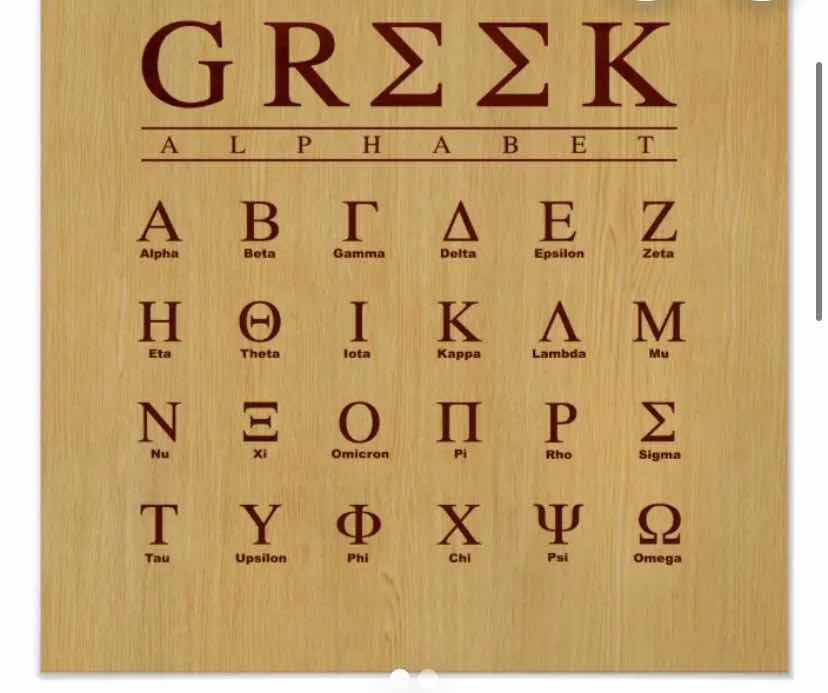
We the Greek Alphabet Formally Denounce our Association with COVID

To WHO it May Concern,

And by WHO, we literally mean WHO—the World Health Organization—which has crossed yet another line by naming yet another variant of the deadly COVID-19 virus after one of our 24 esteemed members.

Before COVID, the general population didn’t give us much thought, despite the fact that we’ve existed since the 9th century BC. That’s 900 years before Jesus H. Christ himself was born in his manger, BTW, for those keeping track.

We didn’t mind so much when American sorority sisters and fraternity brothers hoisted their red Solo cups full of Natty Light and belted us out in a drunken sing song —“alpha beta gamma delta epsilon zeta eta theta iota kappa lambda mu nu xi omicron pi rho sigma tau upsilon phi chi si omeeeeeeeega!” 

That was fine. At least these dumb drunk children were trying to get to know us—the REAL us.

We were also fine with pi/pie day, being a stand-in for first and last (alpha and omega), and even a gamma ray, albeit deadly. We were OK with beta testing and Delta airlines (come to think of it that might be a different Delta). Certainly it was an honor when capital sigma was used to indicate sums in mathematics and when we all jointly inspired the Etruscan, Latin, and Glagolitic alphabets in the 900s.

Really everything was more or less chill until WHO — again the health organization, not the band —started naming mutated versions of a deadly pandemic virus after us. That’s where we have to draw the line. In May 2021, the WHO announced that “the variants of SARS-CoV-2 would be named using letters of the Greek alphabet to avoid stigma and simplify communications for non-scientific audiences.”

Well. 

Needless to say, we did not and do not grant permission for our likeness to be used in such a manner. Avoid stigma? What about the stigma to delta—who was unfairly stigmatized for yanking the rug out from under “hot vax summer” and sending everyone’s crotch fruit back to Zoom school? Or the stigma to omicron, whose very name now strikes fear in hearts across the globe, and who is already being blamed for shitting up Christmas and causing even more breakthrough infections than delta? 

We were willing to accept being named after hurricanes, which at least are kind of badass. But not this. We will not co-sign being used as a scapegoat to “simplify communications” for any audience, scientific or otherwise. 

Among other things—and in case you’ve been living under a rock for the last two years or just making sourdough—no amount of simplification is enough to convince dumbassess to get the fucking vaccine before the virus makes enough versions of itself for all 24 of us to have our own eponymous variant.

We enjoy a storied history as the earliest known alphabetic script to have distinct letters for vowels as well as consonants. We conquered all 22 letters of Phoenician. We introduced three new consonant letters to accommodate aspirated plosive sounds and consonant clusters. We have graced the lips and literature of the GOAT philosophers and scientists like Socrates, Aristotle, and Plato to name a few. Why the very stars of the firmament bear our names, for fuck’s sake!

In closing, we are more than just a shorthand for the apocalypse. Please educate yourself and do better.

Sincerely,

The Greek Alphabet


Monday, November 1, 2021

Why CourtView is the Best Dating App in Alaska

I posted about this topic earlier, but I think it deserves the long-form treatment.

I’m always surprised that more people are unaware of the treasure trove of public information contained in the Alaska Court System records database known as CourtView.

CourtView is mostly a tool for litigants and lawyers to track their cases, but it’s also a crucial dating application here in Cold Florida, as it allows people to screen future romantic prospects for their often lengthy criminal and civil records. 

Since I’m not in the North Mississippi Meat Market, I have to take it as an article of faith on the word of my friends: every dating app that geolocates the user in Alaska should automatically link to CourtView.

Public access to court records is one thing the State really gets right over the feds. Uncle Sam shakes you down just to search cases in an unwieldy electronic software scam known as “PACER.” Therefore, if your future paramour is on the hook for bank robbery, sex trafficking, gun-running, tax evasion, narcotics distribution, or racketeering, I’m afraid you’re shit out of luck because those PACER fees add up right quick.

HOWEVER, if your lover-to-be is a run-of-the-mill murderer, arsonist, sex offender, serial stalker, debtor, Medicaid fraudster, or thrice-divorced bigamist who’s changed their name multiple times to evade detection, then CourtView is where you’ll know for sure. As soon as you swipe right, any dating app worth a download would automatically ping your location as Militiasota and take you straight to CourtView.

Indeed, for the more seasoned purveyors of the “odd goods” that have sifted down into the far outer reaches of the country like so much river sediment, CourtView is a verb. “Did you CourtView them?” is the first question any good friend will ask before you venture out into the wild with someone up here. The sigh of relief when you discover they’ve only registered a will and gotten pulled over for speeding and expired vehicle registration is audible. 

But more troubling, you could unearth successive long-term protective orders issued upon the request of multiple petitioners, or a contentious divorce that contains such pleadings as “Motion to Establish Custody of Parakeet/Order Denying Motion for Parakeet Custody.”

Just like anything else on the internet, you should take what you find on CourtView at face value and not jump to any conclusions. That said, being under third party custody while awaiting trial on armed robbery charges MIGHT be a bad sign. As far as I’m aware, CourtView does not have a mobile app, but I can’t say it enough: it’s the best dating app in Alaska.


Friday, October 8, 2021

Guest Post: Are Jews “White?” by Ivan Hodes, “Known Leftist”

There have been at least seven events in 2021 in which Alaskan antisemitism has been on display: 
1. Anchorage Assemblywoman Jamie Allard defending Nazi-themed license-plates in January.

2. Failed mayoral candidate Heather Herndon complaining about the “Jew Lawyers” like “Jew Dunbar” who control Anchorage.

3. The unearthing of a 2013 Hitler-praising paean by Anchorage Mayor Dave Bronson.

4. Governor Mike Dunleavy’s early-September comparison of public-health mandates as something out of “someplace in Europe in 1939”

5. Rep. Sara Hannan’s bizarre claim that Nazi torture-experiments involving hypothermia “produced results”

6. Rep. David Eastman’s posting a link to a Holocaust-denial website in mid-September; and 

7. The aforementioned Mayor Bronson’s defense of the wearing of Stars of David by white people throwing tantrums about masks and/or vaccines[1]
One Hot Mess and other "tart bloggers" often identify what’s happening as “Whiteness” on full display. But what does that mean? If Jews are white—and it sure looks like we are, at least here in the United States-- how can antisemitism be an expression of Whiteness?

Well, it's complicated, so buckle up.  

Growing up in an upper-middle-class milieu in Indianapolis, Indiana, in the 1980s and ’90s, I never thought of myself as anything other than a white kid, although I was always aware of a Jewish identity. My parents were non-practicing atheists, in fact—and therefore so was I. We celebrated Hannukah, mostly as an excuse to spoil me with a present a night; but we also celebrated Christmas, and never went to synagogue. 

Below is my kindergarten school picture. I was a blue-eyed Jew. I was born at Methodist Hospital, played softball in the Tabernacle Presbyterian church league, went to summer camp at the Flat Rock River YMCA camp, and attended St. Richard’s Episcopal School from kindergarten through 8th grade. Being Jewish was different--not as different as the handful of Black kids there; not as different as my Hispanic-American classmate; a little more different than my Hungarian-American classmate—but just a different kind of white kid--although my mother, accurately enough, liked to point out that my skin color was actually “pinky-beige.”

And yet.

There was a country club in Indianapolis, to which a number of my schoolmates’ families belonged, that did not allow Jews.[1] Golf, tennis and swimming—and I should add here that having the social and financial wherewithal to even think about joining a country club was itself an obvious privilege denied to most citizens of Indianapolis—have exactly nothing to do with religious beliefs, and indeed it should not come as a surprise that Riviera didn’t allow Black members, either. Of course, this was true not just at this one club, but vast numbers of country clubs, affluent suburbs, fraternities, and sororities across the country, North and South, East and West. 

This wasn’t about religious practice, it was about racial identity; while Judaism is a matter of faith, Jewishness is a matter of race. So while Jews, while not non-white in the sense that Black Americans are non-white, have never quite been completely white. 

So what are we?

We could start with genetics. Genetic studies show that Ashkenazi Jews (who comprise about 90-95% of American Jews today) have a distinct genetic profile, most famously manifesting itself in a number of genetic disorders to which we are prone. That profile is much more closely related to other Semitic peoples of the Middle East—i.e., to Arabs—than it is to Europeans, which is what you’d expect for a group of people who lived in the Middle East for many thousands of years before migrating into what is now Europe in the 900s AD, and largely frowned on intermarriage.

Therefore, if Arabs aren’t white, then Jews must not be white, either; if Arabs are white, then Jews must be white, too . . . right? So . . . are Arabs white? Sometimes!

The Lebanese-American community, largely Christian and present in America since the 1870s, is mostly seen as white—at least, it was until 2001. Ralph Nader and Casey Kasem are famous members of this heritage). First-generation Muslim immigrants from Egypt are not usually seen as white.

If all these “largely” and “usually” and “until 2001” caveats seem weird for what looks like a yes-or-no question, it’s because whiteness or the lack thereof is NOT a yes-or-no question, and it doesn’t really have much to do with genetics: racial categories existed long before anyone knew what DNA or even a gene was. Race is a social category, not a biological one, and so the answer to the question “who is white?” has varied from time to time and from place to place. 

White people are whoever most people decide are white people.

In the antebellum south, for example, Jews were clearly white: they could (and did) own slaves and vote; the Confederate Secretary of the Treasury was Jewish. In the Jim Crow era, Southern Jews drank at the whites-only water fountains and went to whites-only schools. In America, Jews were occasionally formally (and more often informally) denied access to various things that entirely white people had (like country club memberships), but they could usually gain that access by assimilation: converting to Christianity or at least avoiding the outward trappings of Jewishness. Barry Goldwater, whose father was Jewish but who was raised in the Episcopal faith of his mother, achieved full whiteness via this path. It might have sometimes caused a small scandal and resulted in playground harassment if someone was discovered to have had a Jewish grandparent, but it rarely resulted in legalized discrimination.

In Europe during the World War II era, on the other hand, Jews were very clearly not white. 

The Nazis' insanely baroque racial hierarchy system elevated Aryans as the whitest of white, but other Europeans were still white, except for Slavs, unless they were Slavs who enthusiastically embraced Nazism (like I said: baroque). But Jews were very definitely considered a different race, and were viewed—like Ruma and Sinti people, the only other ethnic groups targeted for outright extermination by the Nazis--as outsiders sojourning in Europe rather than Europeans. 

Converting wouldn’t help; to Nazis, being Jewish was a matter of blood. The 1933 Nuremberg Code, the first legal encoding of Nazi antisemitism (based at least partly on the Jim Crow segregation laws of the American South) stripped anyone more than half-Jewish of their citizenship. In practice, most Jewish Germans who had an “Aryan” spouse or parent survived the Third Reich because they had citizens who could advocate on their behalf; those who were fully Jewish and tried to rely on their neighbors instead of their family for protection mostly met a bad end. And the vast majority of Jews killed in the Holocaust were Polish and Soviet citizens who never had a chance at all.

For reasons that remain unclear to me, in the decades after Nazism was ground into powder by the Eighth Air Force and Soviet soldiers riding American trucks, the losers’ ideology crossed the Atlantic and grafted itself to the American racial system, which revolved (then and now) around the central axis of whiteness and blackness. Modern American white supremacy/Neo-Nazism is deeply weird and idiosyncratic, and the particulars can vary from loser to loser. 

Some, like Rep. David Eastman, appear to think that the Holocaust is a hoax foisted upon a gullible world (by the Jews, obviously); others think it happened and was great; others yet, unlike the historical Nazis, can square support for a Jewish state in the Middle East with their antisemitism. 

But the basic idea goes something like this: Jews are members of a highly distinctive and white-hating race. Unable to compete with Whitey on the level playing field of a racially homogenous or racially stratified society, the wily Jew manipulates society, controlling the levers of banking and media to promote racial heterogeneity. This, to the white supremacist, is why Jews are the secret power behind the thing that most threatens Whiteness: interracial marriage.

It needs to be pointed out very clearly that when Jews like me and One Hot Mess talk about Whiteness, with a capital W, we don’t simply mean people who belong to the racial category referred to as "white."  Whiteness means actively anchoring your White racial identity to the center of your political and cultural identity; it means believing that providing complete political, social, and economic equality to non-White people is a threat to the White way of life. It means recognizing that the future of America is multi-racial, and instead of celebrating this fact, feeling yourself under siege from the encroaching advance of demographics. 

Distilled essence of Whiteness can be seen here, in this clip from a town hall in Anchorage’s locus of Whiteness, Eagle River, in February of 2021: In response to a complaint about people not wearing masks, a puffed-up and enraged White man demands to know if he is “also too white for you?” These people feel that their racial identity is constantly under assault with,—of course and as usual—surreptitious Jews pulling the strings.

It is hard to logically square this with these same white folk cosplaying Jewish victims of the Holocaust, because this shit is dumb as fuck and not logical at all. But as I learned in Iraq, just because something is dumb as fuck and illogical, doesn’t mean it’s not really happening, and this is really happening. 

The same people wearing and/or defending Stars of David as victimhood cosplay are, literally, the same individuals who defended the Nazi-themed license plates at the beginning of this year: therefore, we know they are not being worn “in solidarity with Jews.” Indeed, comparing routine public health measures to the Holocaust is itself a form of Holocaust denial, because it trivializes and minimizes the actual suffering of actual Jews. If the whitest fear is to be treated the way that Whitey treated Black people, then the greatest antisemitic fear is to be treated the way that antisemites treat Jews. Wearing yellow-star badges is a projection of that fear.

The political power of those who center their own Whiteness has seen a shocking surge in the last decade or so: one of them even became President. Among the least charming developments of my adulthood has been the realization that some appreciable fraction of my neighbors (about 16%, according to this poll)—including at least one state legislator--would throw me in a gas chamber, while some much larger fraction would stand by and do nothing while it happened. 

So although my physical appearance renders me functionally white and I reap the daily benefits of white privilege—I can jog through a wealthy neighborhood without having the cops called on me; I can go to a convenience store late at night without fear of getting shot by cops, and so forth—I, and everyone in this country who identifies themselves loudly as Jews—will never be white enough for Whitey. 

I am excluded from their definition of Whiteness and therefore categorically reject it. I have to stand in solidarity with all the people whom Whiteness threatens and persecutes. Therefore, although I can’t speak for any other member of the tribe, this blue-eyed Jew is not white.

[1] Rep. Hannan has apologized for her comments; Mayor Bronson has apologized for his defense of the Stars of David, but not for his 2013 essay. The others remain publicly unrepentant.

[2] Some Internet sleuthing has revealed that Riviera was opened to Jews in 1981, a year before I was born, as the result of a lawsuit. I nevertheless have vivid childhood memories of my parents telling me that “Rivvy” did not allow Jews at that time.


Ivan Hodes, known leftist, has lived and worked in Anchorage for 16 years. He has a degree in European history from the United States Military Academy and is a veteran of Operation Iraqi Freedom. The views expressed are his alone and do not necessarily represent the views of the Department of Defense or its components.